

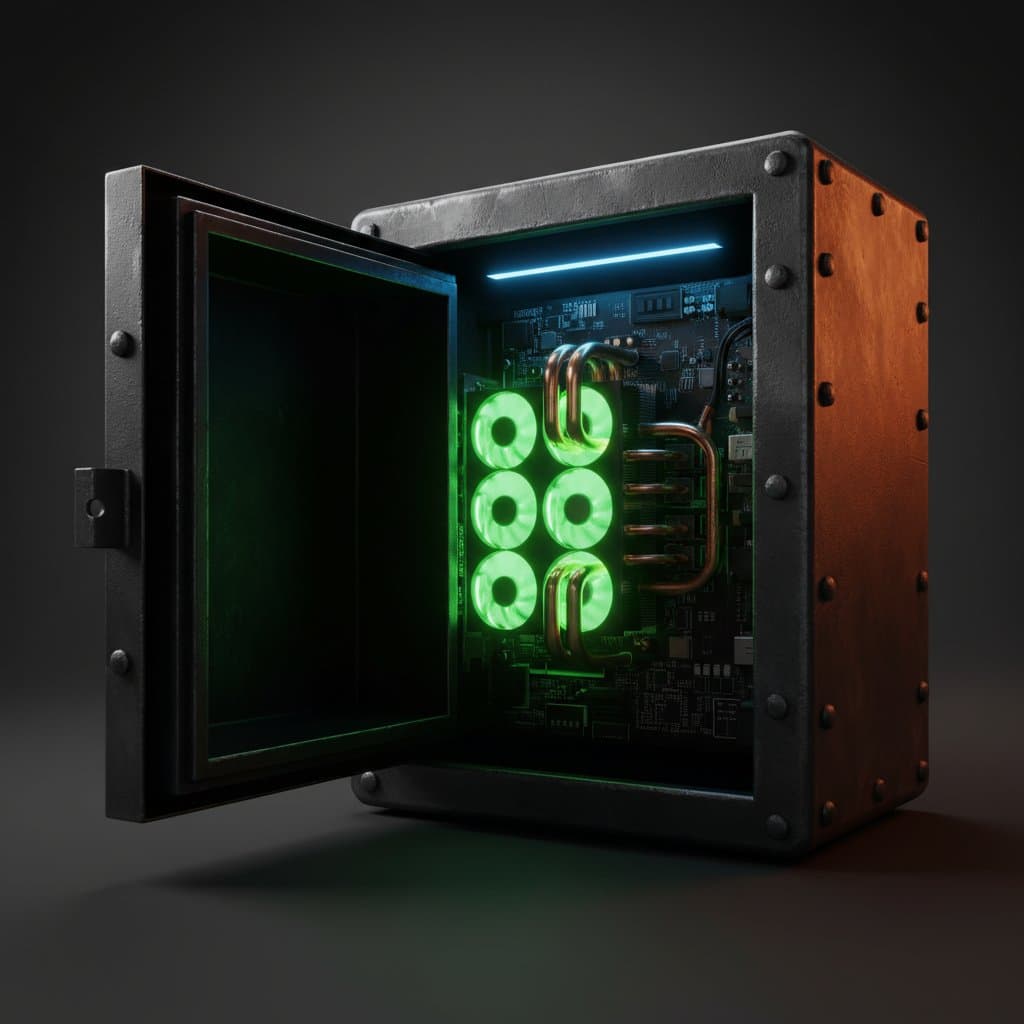
Local LLM Systems: Running Open-Source Models on Your Own Hardware
TL;DR: Open-source models like Qwen3, Llama 4, and DeepSeek-R1 have reached commercial quality in 2026. With GPUs starting at $2,000 and deployment tools like Ollama or vLLM, businesses can run LLMs on their own hardware — with full data sovereignty and long-term cost savings over cloud APIs.
Cloud APIs are convenient. An API key, a few lines of code, and the language model responds. But with every prompt that passes through someone else's servers, companies give up control — over data, costs, and availability. The alternative: open-source models on your own hardware. What required deep expertise two years ago is a realistic scenario for businesses of every size in 2026.
This article covers which open-source models are production-ready today, what hardware you need, which deployment tools simplify operations, and how industries from legal to consulting to healthcare can benefit concretely. The foundation for this — GDPR-compliant architectures and data sovereignty — is covered in our article on GDPR-compliant AI and on-premise LLMs.
Why Local LLM Systems Matter in 2026
Three developments have changed the field:
Open-source models have reached commercial quality. Qwen3, DeepSeek-R1, Mistral Large, and Llama 4 deliver results comparable to GPT-4o or Claude for many tasks. For specialized applications — document analysis, classification, code review — fine-tuned open-source models often outperform generic commercial alternatives.
The toolchain is production-ready. Ollama, vLLM, llama.cpp, and Text Generation Inference (TGI) make running LLMs on your own hardware as straightforward as deploying a web application. OpenAI-compatible APIs enable switching between frameworks without code changes.
Hardware is becoming more accessible. NVIDIA's RTX 5090 (32 GB VRAM) matches H100 performance for 70B models in a dual configuration — at a fraction of the cost. Quantization enables running large models on consumer hardware. For a detailed comparison of current GPU options and concrete build configurations, see our Hardware Guide: Local AI Server vs Cloud.
McKinsey's Technology Trends Outlook 2025 shows generative AI adoption in enterprises jumped from 33% to 67%. According to Gartner, over 80% of enterprises will deploy generative AI in production by 2026. Those who control their own infrastructure retain data sovereignty and cost control.
"The biggest advantage of local LLMs isn't the cost savings — it's the control. When you're processing sensitive client data or patient records, the question isn't whether you'll move from cloud to your own hardware, but when." — Jamin Mahmood-Wiebe, Founder of IJONIS
Open-Source Models Overview: The Key Options
Llama 4 (Meta)
Meta's Llama family is the de facto standard in the open-source LLM space. Llama 4, released in April 2025, introduces a Mixture-of-Experts (MoE) design that significantly improves inference efficiency. Previous versions — Llama 3.1 (8B, 70B, 405B) and Llama 3.3 (70B) — remain relevant for many use cases and run on moderate hardware.
Strengths: Large community, extensive fine-tuning ecosystem, excellent tooling support, strong benchmark results across many tasks.
Hardware requirement: Llama 3.1 8B runs quantized on 8 GB VRAM. Llama 3.1 70B needs 48 GB+ (A6000 or dual RTX 5090). Llama 4 (MoE) significantly reduces active parameters per token.
Qwen3 (Alibaba)
Qwen3 is Alibaba's answer to Western open-source models — and a formidable one. The flagship Qwen3-235B uses an MoE design with only 22 billion active parameters per token, enabling high quality at relatively moderate VRAM requirements.
Strengths: Outstanding at reasoning, code generation, and multilingual tasks. Native context length of 32,768 tokens, extendable to 131,072 with YaRN. Apache-2.0 license — unrestricted commercial use.
Hardware requirement: Qwen3-235B (MoE) needs approximately 48 GB VRAM at 4-bit quantization. Smaller variants (Qwen3-32B, Qwen3-8B) run on consumer GPUs.
Mistral (Mistral AI)
Paris-based Mistral AI delivers the sweet spot for many enterprise applications with Mistral Small 3 (24B). The model achieves state-of-the-art benchmarks, handles long contexts reliably, and fits on GPUs with 24 GB+ VRAM. Mistral 7B remains the gold standard for resource-constrained environments.
Strengths: European provider (relevant for compliance discussions), excellent value for smaller models, strong instruction-following quality.
Hardware requirement: Mistral 7B quantized fits in 4-5 GB VRAM. Mistral Small 3 (24B) needs approximately 16 GB at 4-bit quantization.
DeepSeek-R1 and DeepSeek-V3.2
DeepSeek made waves in early 2025 with the "DeepSeek moment": the R1 model demonstrated ChatGPT-level reasoning at significantly lower training costs. DeepSeek-V3.2 builds on the V3 and R1 series and ranks among the best open-source models for reasoning and agentic workflows.
Strengths: Excellent reasoning, particularly for mathematical and analytical tasks. Chain-of-thought capabilities at commercial level.
Hardware requirement: DeepSeek-R1 (distilled versions) runs on consumer hardware. The full V3.2 model (671B) requires multi-GPU setups with 8x H200 or comparable.
Kimi K2 / K2.5 (Moonshot AI)
Moonshot AI released Kimi K2 (July 2025) and Kimi K2.5 (January 2026) as impressive open-source models. K2 is an MoE model with 1 trillion total parameters but only 32 billion active parameters per token. K2.5 adds native multimodal processing (text, image, video) and was further trained on 15 trillion mixed tokens.
Strengths: Extremely strong coding capabilities, agentic tasks, multimodal processing (K2.5). Context window up to 256,000 tokens. Modified MIT license.
Hardware requirement: Thanks to MoE architecture, K2 runs at 4-bit quantization on an A6000 (48 GB VRAM) or comparable. Weights are available on Hugging Face.
GLM-4.7 (Z.ai / Zhipu AI)
GLM-4.7, released in December 2025, is Z.ai's (formerly Zhipu AI) flagship coding model. Unlike earlier GLM versions, GLM-4.7 is specifically engineered for agentic coding — autonomously completing complex programming tasks across multiple files and turns.
Strengths: Specialized in code generation and code review, MIT license, no API lock-in. Earlier versions (GLM 4.6, 355B) suit broader enterprise applications.
Hardware requirement: GLM-4.7 is optimized for coding efficiency. ChatGLM-6B runs at INT4 quantization on 6 GB VRAM — ideal for fast iteration cycles.
Model Comparison: Which Model for Which Task?
Hardware: What You Need for Local LLM Inference
Your hardware choice determines which models you can run and how performant inference will be. The GPU is the decisive factor — specifically the amount of VRAM.
GPU Overview: Cost and Performance
The Role of Quantization
Quantization is the technique that brings 70B-parameter models to consumer hardware. Instead of storing each parameter as a 16-bit floating point number (FP16), 4-bit quantization (Q4) reduces memory requirements by a factor of 4 — with minimal quality loss for most applications.
Practical example: Llama 3.1 70B requires approximately 140 GB VRAM at FP16. Quantized to Q4, it fits in approximately 35 GB — and runs on two RTX 5090s (32 GB each) or one A6000 (48 GB).
Recommendation by Use Case
The RTX 5090 is the breakout story of 2025/2026: in benchmarks, a dual RTX 5090 configuration matches H100 performance for 70B models — at roughly 25% of the cost. For prototyping and internal tools, this is a game-changer.
Deployment Tools: From Model to API
Ollama: The Starting Point
Ollama has established itself as the most popular tool for local LLM operation. A single command is all it takes:
ollama run llama3.2
Ollama is built on llama.cpp, offers intelligent memory management, GPU acceleration (CUDA, Metal, ROCm), and an OpenAI-compatible API. The model directory includes Llama, Mistral, Qwen, Phi, and more.
Ideal for: Prototyping, local development, internal tools with limited user count.
Not ideal for: High-load scenarios with many concurrent requests.
vLLM: The Production Solution
For production deployments, vLLM is the gold standard. Its PagedAttention technology reduces memory fragmentation by 50%+ and increases throughput for concurrent requests by a factor of 2–4. Under peak load, vLLM delivers over 35x more requests per second than llama.cpp.
vLLM provides OpenAI-compatible APIs, continuous batching, and native support for function calling — ideal for AI agent systems, as we describe in our article on AI agents for enterprises.
Ideal for: Production APIs with SLAs, multi-user scenarios, enterprise deployments.
Not ideal for: Edge deployments, CPU-only environments.
llama.cpp: Maximum Portability
llama.cpp is written in pure C/C++ with no external dependencies. It runs on servers, laptops, smartphones, and embedded systems. Its quantization options are the most comprehensive in the ecosystem.
Ideal for: Edge deployments, offline scenarios, maximum hardware control.
Not ideal for: High-load multi-user scenarios.
Recommended Deployment Strategy
The proven strategy is: Ollama for prototyping, vLLM for scaling, llama.cpp for edge deployments. At IJONIS, we guide companies along exactly this path — from the initial model evaluation to production-grade on-premise deployment. The key point: all three frameworks offer OpenAI-compatible APIs. If you develop your application against this standard interface, you can switch between frameworks without changing application code. We also describe this API portability in the context of RAG systems in our guide on RAG systems for enterprises.
"We see the same tipping point with clients in Hamburg over and over: once monthly API costs hit five figures, own hardware pays for itself within weeks. And then comes the bonus — no more dependency on providers who can change their pricing tomorrow." — Jamin Mahmood-Wiebe, Founder of IJONIS
Industry Applications: Where Local LLMs Deliver the Most Value
Legal
Law firms and legal departments process highly sensitive client data. Cloud APIs are unjustifiable for many use cases — attorney-client privilege and professional regulations set strict boundaries.
Concrete use cases:
- Contract analysis: Local LLMs extract clauses, identify risks, and compare contract versions. A fine-tuned Qwen3-32B on an A6000 server analyzes hundreds of contracts per day without a single byte leaving the network.
- Case law research: RAG systems with local embeddings search internal case law databases. The model finds relevant precedents and summarizes them.
- Compliance review: Automated review of documents against regulatory requirements — EU AI Act, GDPR, industry-specific regulations.
Recommended setup: Qwen3-32B or DeepSeek-R1 (distilled) on A6000, vLLM as inference server, anonymization pipeline upstream.
Consulting
Strategy consultancies work with confidential client data, market analyses, and internal strategy documents. A local LLM system becomes an internal knowledge assistant.
Concrete use cases:
- Pitch preparation: The model analyzes industry reports, extracts relevant data points, and creates draft presentations.
- Document synthesis: Summarizing interview transcripts, workshop results, and market data into structured reports.
- Knowledge management: A RAG system built on the internal knowledge base enables natural-language search across thousands of project reports and best practices.
Recommended setup: Llama 4 or Mistral Small 3 on dual RTX 5090, Ollama for prototyping, migration to vLLM as usage grows.
Healthcare
Patient data is subject to special protection requirements (Art. 9 GDPR / HIPAA). Local LLM systems are not optional here — they are often the only justifiable architecture.
Concrete use cases:
- Clinical documentation: The physician speaks with the patient, the local LLM transcribes, extracts symptoms, diagnoses, and medications, and converts everything into the structured patient record. The physician reviews and confirms.
- Report summarization: Automatic summarization of lengthy diagnostic reports for ward rounds — locally, without cloud transmission.
- Drug interaction checking: RAG systems with medical databases check interactions in real time.
Recommended setup: Mistral Small 3 or Qwen3-32B on dedicated hardware within the hospital network, strict network isolation, audit logging.
Financial Services
Regulated financial institutions face strict requirements for data processing by third parties. Local LLMs enable AI-powered analysis without outsourcing risks.
Concrete use cases:
- Risk assessment: Analysis of credit applications, balance sheets, and business reports with local models.
- Regulatory reporting: Automated extraction of relevant data from financial documents for supervisory filings.
- Fraud detection: Local models classify transaction patterns — without sending transaction data to external servers.
Recommended setup: DeepSeek-R1 for reasoning-intensive tasks, H100 for SLA-bound production, vLLM with audit trail.
Manufacturing and Industry
Engineering data, formulations, and process documentation are trade secrets. Local LLMs become technical assistants.
Concrete use cases:
- Technical documentation: Automatic generation and updating of maintenance manuals from CAD data and bills of materials.
- Failure analysis: Machine data and error logs analyzed by the local LLM, root causes identified, and corrective actions recommended.
- Supply chain optimization: Analysis of supplier data and market reports for strategic procurement decisions.
What Does a Local LLM Cost vs. Cloud API?
The economics depend on usage volume. Here is a realistic calculation:
Add personnel costs for DevOps and maintenance (approximately $135,000/year for an MLOps engineer). For regulated industries, compliance costs add 5–15%.
Managed GPU hosting from European providers like Hetzner offers a middle ground: starting at approximately $2,000/month for dedicated GPU servers, without hardware maintenance.
Implementation Roadmap: From Evaluation to Production
Phase 1: Evaluation (1–2 weeks)
- Define use case and document data requirements
- Test 2–3 models on Ollama (local machine or test server)
- Evaluate model output quality with domain-specific test cases
- Derive hardware requirements based on evaluation
Phase 2: Pilot (2–4 weeks)
- Procure hardware or set up managed GPU hosting
- Set up deployment with vLLM or Ollama
- Implement anonymization pipeline (for personal data)
- Onboard 5–10 internal pilot users
- Set up logging and monitoring
Phase 3: Production
- Migrate to vLLM for production load
- Configure auto-scaling and failover
- Set up SLA monitoring and alerting
- Schedule regular model updates and quality reviews
- Update compliance documentation
For a structured approach to this process — from first idea to productive prototype — see our guide From Idea to AI Prototype in 4 Weeks.
FAQ: Local LLM Systems
Do I need programming skills to run a local LLM?
Not for evaluation with Ollama — a single terminal command is enough. For production operation with vLLM, you need DevOps skills: Docker, GPU drivers, monitoring tools. Alternatively, managed GPU hosting providers offer complete packages.
How current are open-source models?
Open-source models have no live data connection. Their knowledge ends at the training cutoff. For current information, combine the LLM with a RAG system that uses your own documents as a knowledge source — an architecture we describe in our article on RAG systems for enterprises.
Can I use an open-source model commercially?
Most current open-source models permit commercial use: Qwen3 (Apache-2.0), Llama 4 (Llama Community License), Mistral (Apache-2.0), DeepSeek-R1 (MIT), Kimi K2 (Modified MIT), GLM-4.7 (MIT). Review the specific license before production deployment — especially for models with modified licenses.
How fast is inference with local models?
It depends on the model, hardware, and quantization. Reference values: Mistral 7B on an RTX 4090 delivers approximately 80–120 tokens/second. Llama 3.1 70B (quantized) on an H100 delivers approximately 40–60 tokens/second. For most enterprise applications — document analysis, summarization, classification — this is more than sufficient.
What happens when a better model is released?
This is one of the biggest advantages of local systems: you swap the model without changing your infrastructure. If you developed your application against an OpenAI-compatible API, you download the new model and start it — done. No vendor lock-in, no contract negotiations.
When Does Switching to a Local LLM System Pay Off?
The technology is here. Open-source models deliver enterprise quality. The hardware is affordable. The deployment tools are production-ready. What separates companies from implementation is rarely the technology — it is a clear plan.
Local LLM systems are particularly suited for businesses that process sensitive data, need to meet regulatory requirements, want to optimize costs long-term, or need full control over their AI infrastructure. Especially in Hamburg, with its strong concentration of logistics, financial, and media companies, we see enormous potential for on-premise AI solutions. In 2026, that applies to more industries and use cases than ever before. For running autonomous AI agents like OpenClaw, local models also provide an escape from expensive API costs and privacy concerns.
Want to evaluate or deploy a local LLM system in your organization? Talk to us — we help with model selection, hardware planning, and deployment. From evaluation to production.