

Multi-Agent Systems in Practice: Architecture, Coordination, and Use Cases
In early 2024, the state of the art in AI-assisted coding was autocomplete on steroids. GitHub Copilot suggested the next line. You accepted or rejected. The human remained firmly in the driver's seat, and the AI was a passenger occasionally reading the map.
Two years later, we are watching AI agents coordinate with each other, debate competing hypotheses, and divide a codebase among themselves like a small engineering squad. The shift from "AI as code completer" to "AI as engineering team" happened faster than most predictions anticipated. And the implications for how software gets built are profound.
This article examines the architecture, practical applications, and honest limitations of multi-agent AI coding, using Claude Code's experimental Agent Teams feature as the primary lens, while placing it in the broader trajectory of where developer tooling is heading.
TL;DR: Multiple AI agents working as a coordinated team solve complex coding tasks faster and more reliably than a single agent — but only when tasks are parallelizable and a well-defined plan is in place.
How Did AI Coding Evolve from Autocomplete to Autonomous Agent Teams?
To appreciate where we are, it helps to retrace the steps. In just two years, the role of AI in software development has fundamentally shifted — from passive code completion through autonomous agents to coordinated teams that tackle complex tasks in parallel.
Early 2024: The Copilot Era. AI coding tools were sophisticated autocomplete engines. Copilot, Codeium, and TabNine predicted the next token. Interaction was line-by-line. The developer maintained full control. Context windows were small. Multi-file awareness was limited. The AI could not run terminal commands, browse documentation, or verify its own output. In our AI code editor comparison, we evaluated this generation of tools.
Late 2024 — Early 2025: The Agentic Turn. Cursor's Composer mode, Windsurf's Cascade, and Claude Code's CLI introduced a fundamentally different interaction model. Instead of suggesting the next line, these tools could execute multi-step plans: read files, write code, run tests, fix errors, and iterate. The developer described intent; the agent executed. This was the leap from code completion to agentic workflows. A single agent, working in a loop of reasoning, acting, and observing.
Late 2025 — Early 2026: The Multi-Agent Shift. The single-agent model hit a ceiling. Complex refactors that touched frontend, backend, and tests simultaneously overwhelmed a single context window. Debugging required exploring multiple hypotheses, but a single agent anchored on its first theory. As The Pragmatic Engineer observed, senior engineers began "kicking off parallel AI agents" as a new workflow pattern. The solution: give the AI agent the same tool humans use for complex projects. A team.
How Do Agent Teams Actually Work?
Claude Code's Agent Teams feature, released experimentally in February 2026, provides a concrete implementation of the multi-agent pattern. Understanding its architecture reveals both the promise and the engineering constraints of coordinating multiple AI instances. Key takeaway: the design mirrors real engineering teams, not abstract computer science concepts.
The Lead-Teammate Model
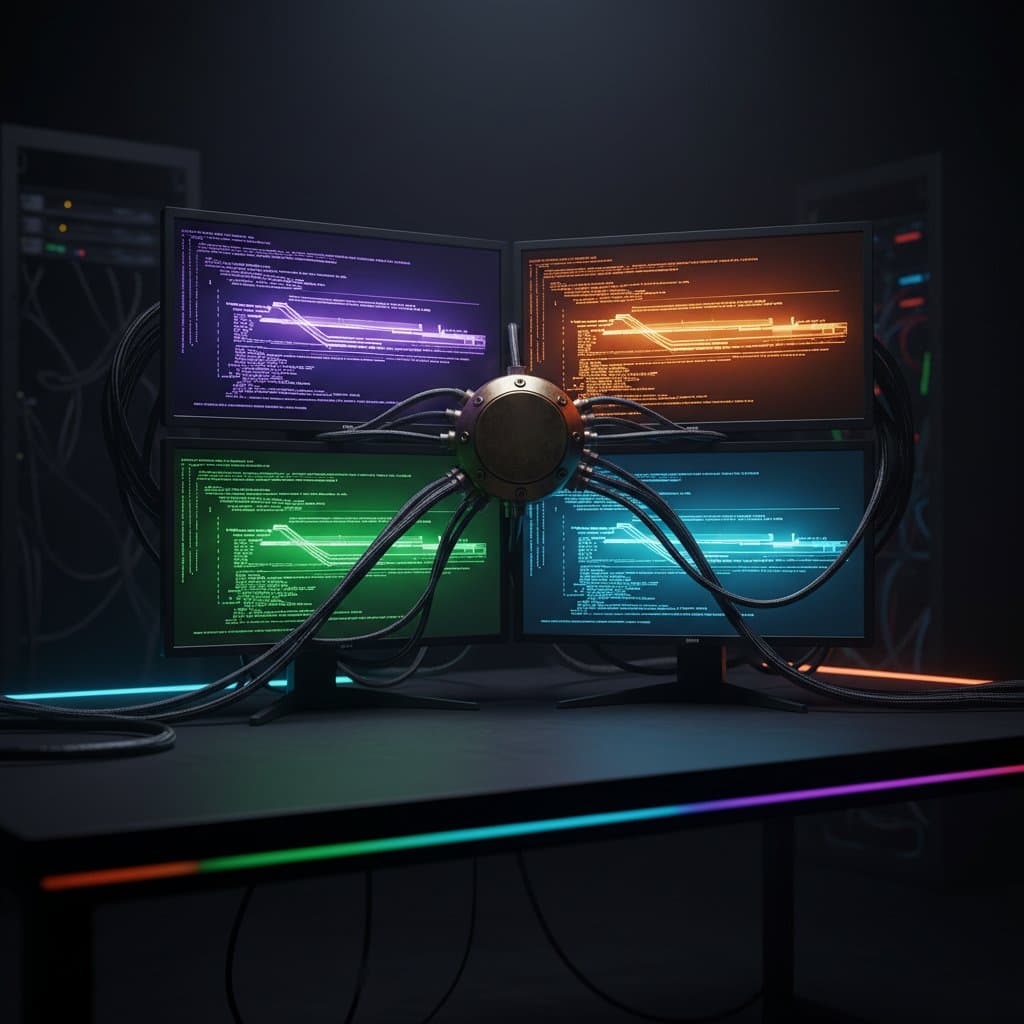
The architecture mirrors a small engineering squad:
The critical architectural distinction from sub-agents: teammates can message each other directly. When a backend agent renames an API field, it can tell the frontend agent immediately, without routing through the lead. This horizontal communication is what makes the system a team rather than a dispatch queue.
Delegate Mode: The Manager Who Does Not Code
A subtle but important feature is Delegate Mode (toggled with Shift+Tab). Without it, the lead often starts implementing tasks itself instead of coordinating. Delegate Mode restricts the lead to coordination-only tools: spawning agents, assigning tasks, sending messages, and reviewing results. No file writes. No terminal commands.
This mirrors a real-world management anti-pattern. The senior engineer who "just quickly" implements a task themselves instead of delegating blocks the team. Delegate Mode enforces the discipline of pure orchestration.
"The biggest mistake we made early on was letting the lead agent write code itself. The moment we switched to pure Delegate Mode, the team's division of labor improved immediately." — Jamin Mahmood-Wiebe, Founder of IJONIS
The Shared Task List
Coordination happens through a shared task list stored in .claude/tasks/{team-name}/. Tasks have three states: pending, in progress, and completed. The system supports dependency chains: Task B cannot be claimed until Task A is marked complete. File locking prevents two agents from grabbing the same task simultaneously.
Quality gates extend this further through hooks. TeammateIdle runs when a teammate is about to stop, and TaskCompleted runs when a task is being marked done. Both can reject the state transition and send feedback, forcing the agent to continue working. This is effectively CI/CD for agent behavior.
Which Use Cases Justify the Overhead?
Multi-agent coordination has real overhead: higher token costs, coordination lag, and setup complexity. Not every task benefits from it. The bottom line: these four patterns consistently justify that cost because they leverage either natural parallelism or mutual quality control.
1. AI-Enforced Test-Driven Development
Spawn two agents. Agent A writes failing tests. Agent B implements the code to pass them. Agent A cannot see Agent B's implementation during test writing, and Agent B cannot start until the tests exist.
Why this matters: when a single agent writes both tests and implementation, it unconsciously writes tests that match its own assumptions. Separating the roles creates genuine adversarial pressure. The tests are written to verify behavior, not to confirm the implementation.
2. Parallel Code Review with Specialized Lenses
A single reviewer tends to gravitate toward one type of issue. Spawn three agents, each with a specific mandate:
- Security reviewer: SQL injection, XSS, authentication flaws, secrets in code
- Performance reviewer: N+1 queries, memory leaks, unnecessary re-renders, missing indexes
- Test coverage reviewer: Untested edge cases, missing error paths, assertion quality
Each agent reviews the same changeset but applies a different filter. The lead synthesizes findings. You get three deep, specialized reviews in the time of one shallow pass.
3. Competing Hypothesis Debugging
When a bug is hard to reproduce, a single agent finds one plausible explanation and stops looking, a phenomenon psychologists call anchoring bias. The antidote: spawn five agents, each assigned a different theory about the root cause.
The agents investigate in parallel and, crucially, debate each other. Agent C's findings might disprove Agent A's theory. This adversarial structure produces more reliable root cause analysis than sequential investigation, because the theory that survives active attempts to disprove it is more likely to be correct.
4. Cross-Layer Feature Implementation
A new feature touching the API, the frontend, and the test suite can be split across three agents working in parallel, each owning a different layer. Dependency chains ensure the frontend agent waits for the API types to be defined before starting. The test agent can begin writing integration test scaffolds immediately.
This is where multi-agent systems shine over single-agent sequential work. When you can write your frontend, backend, and tests in parallel, you compress calendar time without compressing quality.
Why Does the Plan-Then-Swarm Pattern Produce Better Results?
Experienced users have converged on a workflow that consistently produces better results than ad-hoc team creation. Here's what matters: agents without a clear plan hallucinate requirements and produce conflicting implementations.
Step 1 — Plan in single-agent mode. Ask the lead to read the relevant files and produce a detailed plan. No team yet. Just one agent, thinking through the problem.
Step 2 — Critique the plan. Review the plan yourself. Challenge assumptions. Reorder steps. Remove unnecessary work. This is where human judgment has the highest leverage.
Step 3 — Spawn the team with the approved plan. Once the plan is locked, tell the lead to execute it with a team. Each teammate receives specific, approved instructions rather than vague goals.
Why this works: teammates do not inherit the lead's conversation history. They only know what is in their spawn prompt and the project's CLAUDE.md. A well-defined plan ensures they have the context they need. Without it, agents hallucinate requirements and produce conflicting outputs.
"We now spend more time on specifications than on the actual implementation. Sounds counterintuitive, but a precise plan saves three iteration rounds with the agents." — Jamin Mahmood-Wiebe, Founder of IJONIS
What Are the Real Limitations and Risks of Agent Teams?
Agent teams are not magic. The current implementation has sharp edges that every practitioner should understand before investing in multi-agent workflows. The four key constraints involve cost, stability, speed, and knowledge sharing between agents.
Token Cost Multiplication
Each teammate is a full, independent Claude session with its own context window. A team of four agents consumes roughly 4x the tokens of a single session. Anthropic's own engineering team spent $20,000 in API costs during a two-week project using 16 parallel agents to build a C compiler. For most teams, a 10-minute swarm session costs $5-15.
No Session Resumption
If the lead session crashes, the team is gone. You cannot reconnect to orphaned teammate processes. This is the single most frustrating limitation in practice, because it means long-running swarm sessions carry real risk. Save early, commit often.
Coordination Lag
The shared task list uses file locking, which is not instantaneous. Agents sometimes fail to mark tasks as completed, which blocks dependent tasks. The lead occasionally starts implementing tasks itself instead of waiting for teammates. These are the kinds of rough edges that mark an experimental feature.
Context Fragmentation
Teammates do not know what other teammates are thinking, only what they say in messages. If Agent A creates a new utility function but does not message Agent B about it, Agent B may independently create a duplicate. Explicit communication is as important for AI teams as it is for human teams.
Where Is Multi-Agent Coding Headed by 2028?
The trajectory from the last two years suggests where the next two are going. Three phases are emerging: near-term standardization across vendors, medium-term persistent agent teams with long-term memory, and a fundamental shift in the developer's role.
The Near-Term (2026-2027): Standardization and Cost Reduction
Multi-agent coding is not unique to Anthropic. VS Code announced native multi-agent development support in February 2026. OpenAI's Codex app manages parallel agents from a desktop interface. Google's Antigravity project targets the same space. MIT Technology Review named generative coding one of its 2026 breakthrough technologies. The pattern is converging toward a standard: a lead agent coordinating specialized workers with shared state.
Token costs will fall as models get cheaper and more efficient. The current $5-15 per swarm session will become $0.50-1.50. At that price point, multi-agent becomes the default for any non-trivial task.
The Medium-Term (2027-2028): Persistent Agent Teams
Today's teams are ephemeral. They exist for one session and disappear. The next evolution is persistent teams: AI squads that maintain state across sessions, remember past decisions, and build up domain expertise over time. Combined with long-term memory systems, these teams would function less like temporary contractors and more like permanent team members.
The Structural Shift: Developer as Architect
The most important change is not technological but organizational. As Anthropic's 2026 trends report documents, developers already use AI in roughly 60% of their work. Multi-agent teams accelerate the shift from writing code to specifying intent.
The developer's core value is moving toward architecture, system design, and quality judgment. Writing the plan that agents execute. Reviewing the output. Defining the guardrails. This is not a loss of skill — it is the same evolution that happened when compilers replaced assembly language, when frameworks replaced raw HTTP parsing, and when CI/CD replaced manual deployment. The abstraction layer rises. The human moves up the stack.
What Does the C Compiler Project Reveal About Agent Team Capabilities?
To ground the abstract in the concrete: Anthropic's engineering team used Agent Teams to build a 100,000-line Rust-based C compiler capable of compiling the Linux kernel. Sixteen agents worked in parallel over nearly 2,000 sessions. The result passes 99% of GCC's torture tests and can build Linux 6.9 on x86, ARM, and RISC-V.
The project reveals both the ceiling and the floor. The ceiling: a coordinated AI team produced a functioning compiler from scratch. The floor: it cost $20,000 in API fees, required constant human oversight on task design, and the generated code lags significantly behind GCC in optimization quality. The agents needed a human architect defining what to build and a rigorous test suite verifying every step.
The lesson is consistent with everything else in this space: AI agents multiply human capability. They do not replace human judgment.
How Should Development Teams Get Started with Multi-Agent Coding?
For teams evaluating multi-agent AI coding today, four proven strategies offer a clear path forward. Here's what matters: start with low-risk applications and scale incrementally rather than overhauling your entire development process at once.
Start with review, not implementation. Parallel code review and research are the lowest-risk, highest-value entry points. No code gets written. No merge conflicts arise. You learn the coordination patterns without risking your codebase.
Invest in specifications. The quality of agent output is directly proportional to the quality of your specifications. Vague prompts produce vague code. Detailed plans with clear deliverables, file boundaries, and acceptance criteria produce reliable results.
Keep the human in the loop. Monitor your agents. Steer them when they drift. Review before merging. The developer-as-architect model does not mean absence. It means higher-leverage presence.
Watch the costs. Multi-agent sessions consume tokens fast. Start small. Measure ROI per session. Scale when you have evidence that the coordination overhead pays for itself.
FAQ: Multi-Agent AI Coding Teams
What are AI agent teams in software development?
AI agent teams are coordinated groups of independent AI coding instances that work in parallel on different parts of a task. One agent acts as a lead (similar to an engineering manager), breaking down work and assigning it to teammate agents that each have their own context window. Unlike simple autocomplete tools, these agents can communicate with each other, share a task list, and coordinate dependencies.
How much do multi-agent coding sessions cost?
Token costs multiply with each teammate, since every agent maintains a full independent context window. A team of four agents consumes roughly 4x the tokens of a single session. In practice, a 10-minute swarm session typically costs $5-15 in API fees. Anthropic's C compiler project with 16 agents cost $20,000 over two weeks. Costs are expected to drop significantly as models become more efficient.
When should I use agent teams instead of a single AI coding agent?
Agent teams justify their overhead in four scenarios: parallel code review with specialized reviewers, debugging with competing hypotheses, cross-layer feature implementation (frontend/backend/tests in parallel), and AI-enforced test-driven development. For sequential tasks, single-file edits, or routine work, a single agent is more cost-effective.
What is the difference between AI sub-agents and agent teams?
Sub-agents run within a single session and can only report results back to the main agent. Agent teams consist of fully independent sessions that can message each other directly, share a task list, and coordinate without routing through the lead. Teams are better for complex work requiring discussion and collaboration; sub-agents are better for focused tasks where only the result matters.
Why the Coordinated Agent Team Is the Future of AI Development
The progression from autocomplete to autonomous agents to coordinated agent teams follows a clear trajectory. Each step raised the abstraction layer, shifting more tactical work to the machine and more strategic work to the human.
Multi-agent AI coding is not ready for every team and every task today. The costs are high, the coordination is imperfect, and the tooling is experimental. But the direction is unmistakable. Within two years, spawning a team of specialized AI agents for a complex feature will be as routine as opening a pull request.
The question for engineering organizations is not whether to adopt multi-agent AI development. It is whether to build the organizational muscle for it now, while the tooling is still forming, or later, when the patterns are established and the competitive advantage has shifted to those who moved first.
Building with AI agents or evaluating multi-agent development workflows? At IJONIS, we work with these tools daily. Talk to us about integrating agentic coding into your development process, or explore our deep dives on agentic workflows, AI agents for enterprises, and the Trust Spectrum for agent safety.