Zum Inhalt springen
Blueprintenergy

Integrating a Field Services Company's Data Sources Into One Intelligent Hub

How a growing HVAC services business consolidates six fragmented operational tools into a single unified operational platform — an application of IJONIS's Company OS approach.

PythonReactSupabaseGoogle Cloud (Vertex AI)
Analytics dashboard on a laptop as a visual metaphor for a single unified operational view.
Project at a Glance
10 weeks
Rollout to go-live
6 → 1
Systems unified
15,000+
Legacy documents indexed
5 levels
Intelligence tiers
Deterministic + AI
Trust architecture
africa-south1 / EU
Data residency
Case Study

Challenge

Across the sub-Saharan services industry, growing technical businesses hit the same ceiling: the operating model never scales with revenue. A CRM collects leads. A field app captures jobs. Sage issues invoices. A GPS platform tracks vehicles. An Excel sheet nobody owns holds it all together. According to Fieldservicely, admin tasks consume 30% of field technician hours; 38% of providers report scheduling as their single biggest operational friction.

At FlowServ — 50 staff, 20 vans, 8,000+ customers, installing and maintaining HVAC across South Africa — a typical morning illustrates the cost. The coordinator opens six tools before her first coffee is empty. A reactive callout arrives by WhatsApp; routing it means checking the CRM (service history), the field app (open jobs), Sage (payment status), and a stock spreadsheet that's three days stale. The R240,000 maintenance contract that almost lapsed last quarter was sitting in a technician's WhatsApp, not in the CRM. No one has a consolidated view of the business — not the operations lead, not finance, not the field supervisors. Growth has outpaced the systems that got FlowServ this far.

Solution Architecture

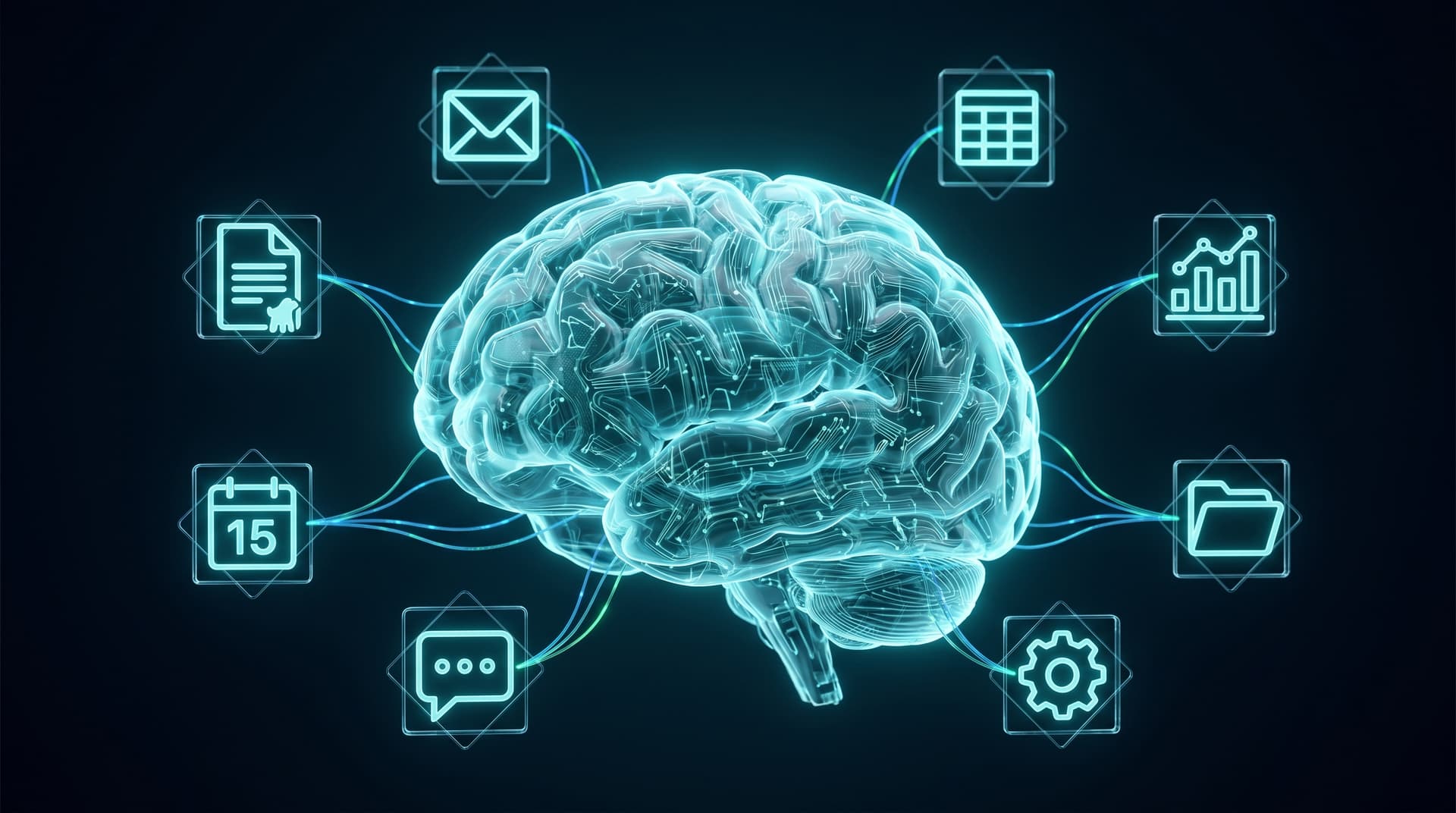
The hub gives FlowServ a single operational platform that the whole company runs on — not another app next to six others, but the layer that absorbs every existing system and collapses them into one surface. From the first lead in the CRM to the final invoice in Sage, every operational signal flows through the hub. The underlying systems of record stay in place — Sage stays Sage, the field app stays the field app — but no one touches them individually any more. Coordinators, supervisors, and the exec team all live in this one surface.

This hub is an application of our Company OS approach — IJONIS's method for absorbing fragmented operational tools into a unified platform and layering AI capabilities on top. Applied here to a HVAC services business; the same structure carries for any growing services operation (logistics, manufacturing, technical services).

On top of that unified foundation, AI capabilities are stacked in cleanly separated tiers — from passive document understanding to autonomous action across system boundaries. Each tier activates independently, controls independently, and audits independently.

The four layers

The hub is deliberately structured into four distinct layers. Each layer has a clearly defined purpose, its own responsibility profile, and scales independently.

1. Integration Fabric — the connector. A read-only connector layer sits over the existing systems and normalises their data into a unified model. The CRM, field app, and Sage are tied in via API, fleet GPS is polled on 60-second intervals, the shared drive of 15,000+ legacy PDFs is structured via document AI, WhatsApp and email coordination are captured through webhook bridges. Everything flows into a single data pipeline in a PostgreSQL layer — the source of truth that everything else sits on. The connector layer surfaces data quality issues (duplicate customers, conflicting addresses, orphan jobs) and flags them before they land in reports or AI outputs.

2. Operational Surface — the Hub UI. On top of that foundation runs the unified interface that every operational role actually works in. It doesn't replace the products underneath — it replaces the switching between six products.

Before — fragmentedAfter — one hub
CRM holds the quote; ops can't see itQuote flows into the job board the moment it's accepted
Field app captures the visit; office waits for syncEvery visit visible in Customer 360 in real time
Invoices typed into Sage manuallyInvoice data pushed from job completion, reconciled in Sage
GPS tracker runs in isolationFleet overlaid on the job board with live ETAs
15,000 PDF job cards on a shared drivePDFs structured, linked to customer and asset, searchable in seconds
Coordination lives in WhatsAppEvery coordination message is logged against the job and is auditable

3. Intelligence Layer — the AI tiers. On top of the surface, AI capabilities are activated across five maturity tiers, each with its own engine and usage pattern. FlowServ can start at tier one and move up — or activate multiple tiers in parallel. Each tier is isolated and independently switchable.

TierEngineWhat happensExample at FlowServ
UnderstandingDocument AI → structured extractionUnstructured inputs (PDFs, emails, POs, WhatsApp messages) turned into searchable data15,000 legacy job cards indexed — "when was the Aliwal North site last serviced?" answered in 2 seconds
ReasoningCross-system query → ranked recommendationCandidates evaluated across every data source against business rules (history, proximity, skills, parts, route)Callout in Polokwane → recommended: Tech A (30min ETA, has the parts on the van, has serviced this site twice before)
GenerationTemplate + operational data → documentClient reports, proposals, handover docs generated on demand from operational dataMonthly Shoprite report: 23 visits, 4 SLA breaches explained, R186,000 billable — generated in 8 seconds
OrchestrationEvent → multi-system action graphOne trigger fires coordinated actions across multiple systemsJob marked "done" → Sage invoice created, customer notified, stock decremented, next service scheduled — 4 systems, 1 trigger
AgenticContinuous monitoring → proactive plan → human approvalSystem watches operational patterns, detects drift, drafts action plans for approvalSame fault across 3 customer sites within 60 days → suggested root cause + proactive maintenance visits + parts pre-staged — queued for ops director sign-off

4. Control Plane — the governance layer. Every AI action passes through a central control layer that gives the business a dial between "suggest", "suggest with approval" and "autonomous execute" — per workflow, per role. Pure information (report generated, notification sent) can run autonomously. Dispatching decisions, customer communication and invoice actions default to human-in-the-loop. Every action — AI-generated or human-confirmed — is logged with timestamp, role, and input data. The business sets the dial; the platform executes what is approved.

Trust Architecture

The hub draws a hard line between what is computed deterministically and what is AI-interpreted — and makes that line visible everywhere.

All operational numbers — job volumes, revenue per customer, SLA compliance, fleet utilisation, stock coverage — are calculated deterministically from the unified data layer. These numbers are never AI-generated. The AI layer sits on top: a retrieval-augmented generation pipeline grounded in the real operational data and in curated policy documents (service levels, dispatching rules, escalation paths).

Every AI output is anchored to specific data points. The model cannot fabricate jobs, customers, parts or visits that don't exist in the data. Where data is missing — a patchy history, an orphan address — the system flags the gap explicitly instead of interpolating. Confidence levels accompany every recommendation. Every business-critical action passes through the control plane gate; token usage per query is tracked and reported.

Data Integration

The hub connects to FlowServ's toolchain through a secure connector layer: API integration with the CRM (live webhooks on quote events, incremental sync for customer master data), the field management app (real-time job completion events), and Sage (invoice push plus reconciliation). The GPS fleet system is polled on 60-second intervals and joined to the active job board. The legacy PDF archive is processed in an initial batch run through document AI (customer mapping, asset extraction, OCR quality scoring) and incrementally thereafter. WhatsApp and email coordination flow through a dedicated inbound agent that attaches messages to the right job.

All credentials are stored encrypted in Google Cloud Secret Manager, never transmitted in plaintext, and use short-lived session tokens invalidated after each run. The connector automatically surfaces data quality issues before analysis: missing reporting lines, duplicate customers, orphan jobs, conflicting addresses.

Deployment & Rollout

Hosted on Google Cloud in africa-south1 (Johannesburg) for data residency; optionally in the European region for EU clients. Progressive activation: Integration Fabric in weeks 1–2 (read-only wiring, initial data harmonisation). Operational Surface live in weeks 3–5 (job board, Customer 360, dashboards — teams are already working in one surface instead of six from here). Intelligence Layer rolled out in weeks 6–10 (Understanding → Reasoning → Generation first; Orchestration and Agentic follow once trust is built). Managed service with monthly iteration cycles for new workflows, new integrations, and control plane adjustments.

Going Further — Autonomous Operations Mode

The query- and event-driven hub is the foundation. For businesses ready to move into agentic territory, the same architecture supports an autonomous operations mode — where the system doesn't just react to events, but proactively spots patterns and initiates action proposals.

Agents monitor operational streams continuously: recurring fault patterns, SLA drift, stock risk, customer churn signals, underused fleet capacity. A standout pattern — say, three similar failures in the same asset class within 60 days — triggers a full proposal: suspected root cause, proactive maintenance visits routed optimally, parts pre-staged, estimated ROI. The operations lead reviews and approves; the system executes across every connected system.

The human role shifts from operating multiple tools to reviewing and approving machine-generated proposals. The control plane gate remains — every business-critical action still requires human sign-off. The initiative, however, comes from the system.

Security & Data Protection (POPIA / GDPR)

FlowServ operates under South Africa's Protection of Personal Information Act (POPIA); European customers deploying the same approach fall under GDPR. The architecture is designed for both regimes — not bolted on afterwards.

Data Isolation & LLM Privacy

All data processing — including LLM inference — runs inside the customer's own Google Cloud tenant via Vertex AI. Google is contractually bound not to use prompts, responses, or uploaded data to train its models. The customer retains 100% ownership of all inputs and outputs.

  • All data encrypted at rest (AES-256) and in transit (TLS 1.3), with optional customer-managed encryption keys (CMEK)
  • Role-based access control — coordinators, supervisors, finance, and execs only see what they are authorised for
  • Tenant isolation — data runs in a dedicated environment, never mixed with other customers
  • Private endpoints and VPC Service Controls route all traffic through Google's private backbone — nothing touches the public internet
  • Deployment in africa-south1 (Johannesburg) or europe-west3 (Frankfurt) for data residency
  • API credentials in Google Cloud Secret Manager with automatic key rotation and short-lived session tokens

For organisations with stricter sovereignty requirements, the architecture supports self-hosted open-source models via frameworks like vLLM — see FAQ.

Audit Trail & Accountability

Every query, data extraction event, AI recommendation, and control plane approval is logged with timestamp and role attribution. This provides the accountability record that POPIA Section 19 and GDPR Art. 30 require. The architecture is aligned with ISO 27001.


A Day at FlowServ — After

07:42. The coordinator opens the hub. The job board shows every open ticket sorted by SLA risk. Three overnight emergencies are already classified, dispatched, and matched to the nearest technicians carrying the right parts — each recommendation with its rationale next to it.

09:15. A customer rings about a quote. The coordinator types the name — Customer 360 surfaces every quote, visit, open invoice, recent WhatsApp thread, and SLA metric on one page. No three tools, no Excel.

11:30. A supervisor checks the week's plan. The Intelligence Layer has spotted a recurring failure across three HVAC units of the same series and proposes a proactive maintenance run, routed optimally, with parts pre-staged. Approved in one click.

16:00. A technician closes a job in the field. The completion automatically triggers: invoice in Sage, customer notification, stock decrement of the parts used, next visit scheduled — without anyone returning to the office.

17:30. The ops director opens the BI layer. Three dashboards side by side: operational (utilisation, SLA), financial (margin per customer, outstanding invoices), predictive (fault trends, next week's capacity forecast). One surface. One truth.

Related concepts: AI agent · workflow automation · API integration · data pipeline · human-in-the-loop.


Why this pattern scales

This hub is not a one-off build for a single business — it's a concrete application of a pattern that holds for any growing services operation. The same four-layer structure (Integration Fabric · Operational Surface · Intelligence Layer · Control Plane), the same five AI maturity tiers, the same trust principles — applicable to logistics, manufacturing, technical services, healthcare.

The hub scales with the business. New service lines are not bolted on with another tool — they are added as workflows inside the existing Hub. New data sources come in through the same Integration Fabric. New AI capabilities activate on an infrastructure that already delivers trust and auditability. That's the difference between another application in the stack and an operational platform that the business actually runs on.

For FlowServ in concrete terms: in ten weeks, one surface instead of six. In three to six months, agentic maintenance proposals with measurable ROI. In a year, an organisation where growth no longer outpaces the systems — it builds on them.

What happens next

This is a composite case study, distilled from our engagements with small and mid-sized services businesses across Europe and South Africa. The company name and specific figures are anonymised — the architecture, rollout plan, and decision logic are exactly what we bring to real engagements. The Company OS approach was built out of that work, not from theory. The real version for your business starts with a two-week assessment: which systems are in use, where the biggest friction sits, which two or three workflows deliver the strongest ROI in the first 90 days. The assessment ends with a prioritised rollout plan — not slides, the actual architecture for your environment.

Next step: Book a conversation — share your setup, and we decide together whether the Company OS is the right architecture for you.

Projected Impact
Six
systems consolidated into one Hub
Five
AI tiers, progressively activated
Rollout
in 10 weeks

This is an engineered blueprint based on publicly available industry challenges. It does not represent work performed for any specific company.

Interactive Demo

What does a hub like this look like in practice?

Explore an interactive click-dummy of a comparable hub — five screens, from the BI dashboard to the AI decisions queue. The prototype is for illustration only — it is not connected to real data and shows how operational work looks inside a single unified system.

Open Demo

Frequently Asked Questions

Does the hub replace our existing systems (CRM, field app, Sage)?+

No. The existing systems remain as systems of record — Sage stays Sage, the field app stays the field app. The hub is the unified surface on top, absorbing the data from every system and consolidating the operational work into one place. No rip-and-replace, no data-migration project.

How long does the rollout take to go-live?+

The Integration Fabric runs in weeks 1–2. The Operational Surface goes live in weeks 3–5 — from that point, teams are already working in one surface instead of six, even without AI. The Intelligence Layer activates progressively in weeks 6–10 (Understanding → Reasoning → Generation first; Orchestration and Agentic follow once trust is built). Typical rollout to full go-live: 10 weeks.

How do you prevent the AI from "hallucinating" jobs, customers, or parts?+

Quantitative numbers are calculated deterministically from the unified data layer and are never AI-generated. The AI layer works exclusively through retrieval-augmented generation: every output is anchored to specific data points. The model cannot invent jobs, customers, or parts that don't exist in the data. Where information is missing, the gap is flagged explicitly — not interpolated. Every business-critical action passes through the control plane gate with human approval.

What savings are realistic?+

[Forrester research](https://www.ringly.io/blog/ai-automation-statistics-2026) puts field-service automation ROI at 210% over three years. [Fieldwork HQ](https://fieldworkhq.com/2025/12/26/field-service-management-trends-in-2026/) reports 20–30% higher technician utilisation from intelligent dispatching. Primary levers at FlowServ: reduced admin time per job, shorter invoice cycles, higher fleet and inventory utilisation. Concrete figures depend on baseline, vertical, and contract mix.

Can we use a self-hosted open-source model instead of Vertex AI?+

Yes. The architecture is model-agnostic. For organisations with stricter sovereignty requirements, the Intelligence Layer can be run on self-hosted models such as Llama 3 (Meta), Mistral Large, or Qwen, deployed through frameworks like vLLM or HuggingFace TGI on your own infrastructure. The trade-off: higher operational overhead (GPU infra, model updates, monitoring) and potentially lower model performance vs. frontier models. For most enterprises, Vertex AI offers the best balance of capability and sovereignty.

Do our customer and operational data ever leave our cloud environment?+

No. All data processing — connector extraction, data pipeline, LLM inference, report generation — happens inside your Google Cloud project. Vertex AI is contractually bound not to use your data for model training, and supports private endpoints as well as VPC Service Controls so no traffic touches the public internet. With customer-managed encryption keys (CMEK), you retain control over access: if the key is revoked, Google can no longer process the data.

Let's talk

Ready to build this?.

Keith Govender

Keith Govender

Managing Partner

Book appointment

Auch verfügbar auf Deutsch: Jamin Mahmood-Wiebe

Send a message

This site is protected by reCAPTCHA and the Google Privacy Policy Terms of Service apply.