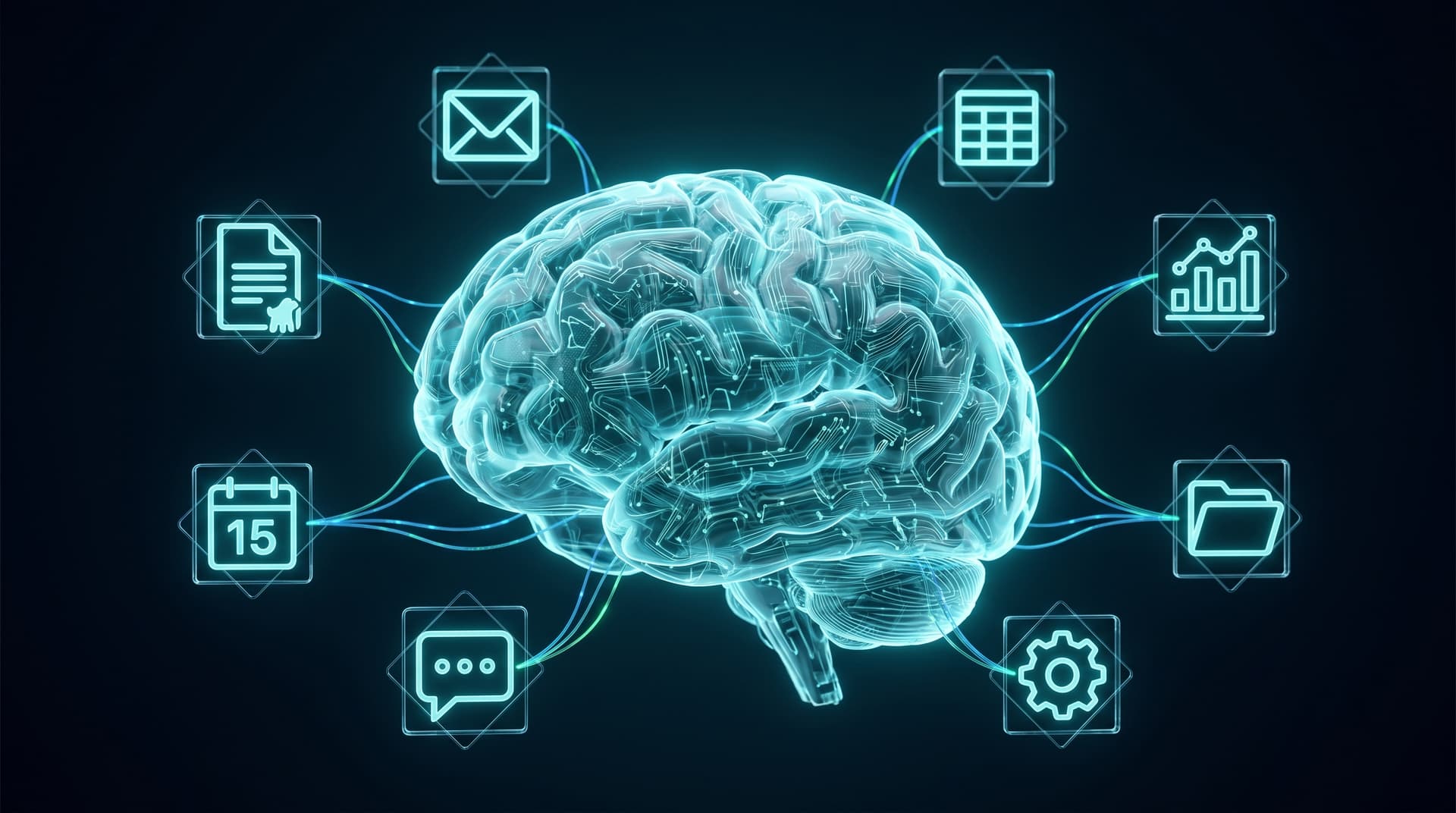
The hub gives FlowServ a single operational platform that the whole company runs on — not another app next to six others, but the layer that absorbs every existing system and collapses them into one surface. From the first lead in the CRM to the final invoice in Sage, every operational signal flows through the hub. The underlying systems of record stay in place — Sage stays Sage, the field app stays the field app — but no one touches them individually any more. Coordinators, supervisors, and the exec team all live in this one surface.
This hub is an application of our Company OS approach — IJONIS's method for absorbing fragmented operational tools into a unified platform and layering AI capabilities on top. Applied here to a HVAC services business; the same structure carries for any growing services operation (logistics, manufacturing, technical services).
On top of that unified foundation, AI capabilities are stacked in cleanly separated tiers — from passive document understanding to autonomous action across system boundaries. Each tier activates independently, controls independently, and audits independently.
The four layers
The hub is deliberately structured into four distinct layers. Each layer has a clearly defined purpose, its own responsibility profile, and scales independently.
1. Integration Fabric — the connector. A read-only connector layer sits over the existing systems and normalises their data into a unified model. The CRM, field app, and Sage are tied in via API, fleet GPS is polled on 60-second intervals, the shared drive of 15,000+ legacy PDFs is structured via document AI, WhatsApp and email coordination are captured through webhook bridges. Everything flows into a single data pipeline in a PostgreSQL layer — the source of truth that everything else sits on. The connector layer surfaces data quality issues (duplicate customers, conflicting addresses, orphan jobs) and flags them before they land in reports or AI outputs.
2. Operational Surface — the Hub UI. On top of that foundation runs the unified interface that every operational role actually works in. It doesn't replace the products underneath — it replaces the switching between six products.
3. Intelligence Layer — the AI tiers. On top of the surface, AI capabilities are activated across five maturity tiers, each with its own engine and usage pattern. FlowServ can start at tier one and move up — or activate multiple tiers in parallel. Each tier is isolated and independently switchable.
4. Control Plane — the governance layer. Every AI action passes through a central control layer that gives the business a dial between "suggest", "suggest with approval" and "autonomous execute" — per workflow, per role. Pure information (report generated, notification sent) can run autonomously. Dispatching decisions, customer communication and invoice actions default to human-in-the-loop. Every action — AI-generated or human-confirmed — is logged with timestamp, role, and input data. The business sets the dial; the platform executes what is approved.
Trust Architecture
The hub draws a hard line between what is computed deterministically and what is AI-interpreted — and makes that line visible everywhere.
All operational numbers — job volumes, revenue per customer, SLA compliance, fleet utilisation, stock coverage — are calculated deterministically from the unified data layer. These numbers are never AI-generated. The AI layer sits on top: a retrieval-augmented generation pipeline grounded in the real operational data and in curated policy documents (service levels, dispatching rules, escalation paths).
Every AI output is anchored to specific data points. The model cannot fabricate jobs, customers, parts or visits that don't exist in the data. Where data is missing — a patchy history, an orphan address — the system flags the gap explicitly instead of interpolating. Confidence levels accompany every recommendation. Every business-critical action passes through the control plane gate; token usage per query is tracked and reported.
Data Integration
The hub connects to FlowServ's toolchain through a secure connector layer: API integration with the CRM (live webhooks on quote events, incremental sync for customer master data), the field management app (real-time job completion events), and Sage (invoice push plus reconciliation). The GPS fleet system is polled on 60-second intervals and joined to the active job board. The legacy PDF archive is processed in an initial batch run through document AI (customer mapping, asset extraction, OCR quality scoring) and incrementally thereafter. WhatsApp and email coordination flow through a dedicated inbound agent that attaches messages to the right job.
All credentials are stored encrypted in Google Cloud Secret Manager, never transmitted in plaintext, and use short-lived session tokens invalidated after each run. The connector automatically surfaces data quality issues before analysis: missing reporting lines, duplicate customers, orphan jobs, conflicting addresses.
Deployment & Rollout
Hosted on Google Cloud in africa-south1 (Johannesburg) for data residency; optionally in the European region for EU clients. Progressive activation: Integration Fabric in weeks 1–2 (read-only wiring, initial data harmonisation). Operational Surface live in weeks 3–5 (job board, Customer 360, dashboards — teams are already working in one surface instead of six from here). Intelligence Layer rolled out in weeks 6–10 (Understanding → Reasoning → Generation first; Orchestration and Agentic follow once trust is built). Managed service with monthly iteration cycles for new workflows, new integrations, and control plane adjustments.
Going Further — Autonomous Operations Mode
The query- and event-driven hub is the foundation. For businesses ready to move into agentic territory, the same architecture supports an autonomous operations mode — where the system doesn't just react to events, but proactively spots patterns and initiates action proposals.
Agents monitor operational streams continuously: recurring fault patterns, SLA drift, stock risk, customer churn signals, underused fleet capacity. A standout pattern — say, three similar failures in the same asset class within 60 days — triggers a full proposal: suspected root cause, proactive maintenance visits routed optimally, parts pre-staged, estimated ROI. The operations lead reviews and approves; the system executes across every connected system.
The human role shifts from operating multiple tools to reviewing and approving machine-generated proposals. The control plane gate remains — every business-critical action still requires human sign-off. The initiative, however, comes from the system.